There is a version of this story that gets repeated a lot, and it goes roughly like this: Wizards of the Coast made a Harry Potter card game, it was a cash-in, it flopped, they cancelled it. Every part of that except the first clause is wrong or, at best, badly incomplete.
The Harry Potter TCG was designed by the people who built Magic: The Gathering. It reached number two on the US card game charts. It got a real organised play program, with leagues, prize support, and monthly developer chats. And then, over about eighteen months, Wizards quietly walked away from it and never publicly explained why.
What follows is what can actually be established from the record: the press releases, the archived developer chats, and the arguments players were having on Pojo while it was happening. Where the record runs out, I say so.
The minds behind the game
The game is credited to Paul Peterson, Skaff Elias, and Mike Elliott. That is not a B-team.
Skaff Elias had been at Wizards since the early Magic days and worked on Arabian Nights, Antiquities, Legends, Fallen Empires, and Ice Age. Mike Elliott is a Magic designer several times over and was later inducted into the Academy of Adventure Gaming Arts and Design Hall of Fame at Origins in 2017. Paul Peterson would go on to design Guillotine and Complete the Mission. These were people who had built the modern trading card game, handed a license that in 2001 was the biggest thing in publishing.
It shows in the rules. The Harry Potter TCG is not a Magic reskin, but it is clearly built by people who had thought hard about why Magic works and what a younger, less patient audience would tolerate. Lessons replace lands, and unlike lands they never sit dead in your hand doing nothing, because Lesson cards provide Power permanently once played. You get two Actions per turn rather than the open-ended turn structure of Magic. There is no life total: you win by decking your opponent, which means every source of damage in the game is doing the same thing to the same clock.
That last decision is the most interesting one. Making the deck itself the resource you are attacking means a new player never has to track two separate numbers, and it makes every card in the game legible to a nine-year-old. It also, as players would eventually discover, made the game extremely vulnerable to a couple of combinations that ended matches far too fast.
The Harry Potter TCG playtest
Six months before Base Set reached a store shelf, Wizards had already shown the game to the public once, in a much smaller way. The American International Toy Fair ran at the Javits Center in New York from February 10 to 14, 2001, and Wizards had a booth there. Collectors have since documented what it was showing.
Demonstrated at this event was a set of 82 preconstructed playtest cards split into two 41-card decks, including 22 lesson cards with no illustrator credit at all. Every card in the group carries a “1st Edition” mark and a card back unlike anything Wizards ever shipped at retail, and all of them are numbered against a print run of 163, a full 47 cards larger than the 116-card set Base Set actually became. A West German gaming magazine, Kartefakt, had also covered the same cards around the same time.
Over the years, I have gotten my hands on three of these extremely hard-to-find beta playtest cards and can confirm that a working build of this game existed and was shown to the public before Base Set was a retail product at all. It's real, and almost nobody knows it happened. What that deck actually contained, and what changed between it and the game that shipped, is a whole story on its own. It is coming as its own post.
The launch of the Harry Potter TCG
Base Set arrived in August 2001, three months ahead of the first film. Quidditch Cup followed in November 2001, timed to the movie's release. Then Diagon Alley in March 2002, Adventures at Hogwarts in June 2002, and Chamber of Secrets in October 2002.
The Chamber of Secrets press release, dated October 1, 2002 out of Renton, Washington, survives in the Internet Archive by way of Pojo. It is worth reading for what it tells you about how Wizards was positioning the game a month before everything stopped:
Scheduled to hit store shelves nationwide beginning October 7, Chamber of Secrets has something to offer every level of TCG player from starter to advanced to expert.
The specifics in that release are useful to collectors now. Two-player starter sets were $9.99 and contained two 41-card decks, each with a character card and an exclusive premium card, plus a playmat/poster, a deck-building guide, and a rulebook. Pre-constructed 61-card decks, also $9.99, appeared for the first time in the game's history with that set. Booster packs were 11 cards at $3.29.
Note the phrase “for the very first time in Harry Potter TCG history.” In October 2002 Wizards was still talking about this game as something with a history and a future, still adding product formats to it. This is not the language of a line being wound down.
It sold.
The claim that the game was, at its peak, the second best-selling card game in the United States turns up in most write-ups. It is plausible and widely repeated, though I have not found the original trade figure behind it.
What I can point to is better, because it comes from a player rather than a press office. In August 2002, a Pojo contributor writing as Legolas published a long complaint titled “The State of Harry Potter.” Buried in the middle of it, he cites Scrye magazine's ranking of TCG sales at the time:
- Magic: The Gathering
- Dragon Ball Z
- Lord of the Rings
- Pokémon
- Yu-Gi-Oh!
- Harry Potter
Sixth. In August 2002, two months before Chamber of Secrets shipped, Harry Potter was outselling Star Wars and sitting in the same conversation as Pokémon and Yu-Gi-Oh!. This was not a game dying of commercial failure. Which makes what happened next stranger, not more obvious.
The collapse of its support
That same article is the best contemporaneous evidence I have found of the game being abandoned from the inside, months before anyone announced anything. Legolas is not speculating about the future. He is describing a support structure that has already stopped functioning:
Many of the past scheduled Harry Potter Chats at wizards.com have been canceled due to the STAFF not showing up. I have been annoying Wizards about this via custserv, but they have not even answered.
He counts eighteen US states with no Harry Potter league at all, and all of Canada served by two. He notes that the Events tab on wizards.com listed Star Wars, Pokémon, Magic, Conventions, Showdown Sports and Chainmail, and no Harry Potter. He notes that the last developer chat had been June 12, and he was writing on August 1.
The other side of it: what retailers were seeing
A week later, Pojo ran a rebuttal from a reader named Mike who had spent three years at a Rider's Hobby Store in Augusta, Georgia, running first the Pokémon league and then the Harry Potter one. His view from behind the counter is the most useful piece of analysis in the whole archive, because it is about the market rather than the publisher.
His four points, paraphrased: retailers had been badly burned by the Pokémon collapse and were ordering conservatively as a result; in his region and others, the witchcraft element of Harry Potter had drawn objections from religious groups, and some retailers avoided the game rather than deal with a boycott; the audience had a famously short attention span; and parents sitting on piles of worthless Pokémon cards were reluctant to fund another collecting habit.
None of that is about the quality of the game. It is about a category that had just eaten itself. Harry Potter arrived in hobby stores at the precise moment the trade had decided that licensed kids' TCGs were dangerous inventory, and that shaped how much of it ever reached shelves.
So why did it actually end?
Here is the honest answer: nobody outside Wizards knows, because Wizards never said.
Every serious source lands in the same place. No press release announced the cancellation. No statement explained it. The line simply stopped, organised play wound down through 2003, and that was the end of it. Anyone who tells you the specific reason is either speculating or repeating someone else's speculation.
What the record does support is a set of pressures, all of them real, none of them individually fatal:
- The licensed-TCG market had turned toxic after Pokémon, and retailers were ordering accordingly.
- Wizards was simultaneously running Magic, Pokémon, and a new Star Wars TCG, and Harry Potter was visibly last in line for staff attention well before it ended.
- The game was built around film premieres, not the books. Every card in all five sets is tied to the first two movies, even though the novel Prisoner of Azkaban had already been on shelves since 1999. The film version would not reach cinemas until 2004, an eighteen-month gap with nothing to launch a set against.
- Late-set power creep left a handful of combinations that ended games almost immediately, a real problem for a format with no banned list and no ongoing development team to fix it.
That last point deserves more weight than it usually gets. A trading card game is not a product you ship, it is a product you maintain. Once the developer chats stopped and the rules staff thinned out to one overworked person, the game had no mechanism left for fixing itself. It did not need to be cancelled to stop working. It just needed to be ignored.
The wider mess at Wizards
It is also worth knowing what else was going on at the company at the time, because the Harry Potter TCG did not die in isolation. The Seattle Times reported at the end of December 2003 that Hasbro, which had bought Wizards for $325 million in 1999, was shutting all of its roughly 60 retail stores nationwide and cutting about 500 jobs, pulling back to designing games and selling them through other people's shops. Wizards had also sued Nintendo of America and Pokémon USA over distribution rights, later settled on undisclosed terms.
The same article mentions one more case, and it is the piece of this story that circulates most and deserves the most care. In 2002 Wizards sued a former executive, Charles T. Federline, over allegations that he had manipulated the printing bids for Harry Potter trading cards. The case never reached a judgement: it was suspended in March 2003 after Federline filed for bankruptcy.
I want to be precise about what that does and does not tell us. The lawsuit is real and was reported at the time. The allegations in it were never tested in court and never proven, and a suspended case is not a finding of anything. You will see it offered online as the reason the game was cancelled, sometimes with a figure of around $93,000 attached. There is no evidence for that link. Wizards never connected the two, the timing is suggestive at best, and a company that had just written off a $325 million retail strategy was not likely deciding the fate of a product line over a sum that size. It belongs in this story as a sign of how chaotic things were inside Wizards while the game was quietly being dropped, not as an explanation for the drop.
The art, which is why any of this still matters
Whatever happened commercially, Wizards made one decision at the start that is the reason people still collect this game: they didn't use movie stills.
Every card in all five sets is an original painted illustration. This archive credits 53 different artists across the game, most of them working comic and fantasy illustrators. Among them are Greg and Tim Hildebrandt, the twin brothers who painted the 1977 Star Wars poster and the Tolkien calendars of the mid-seventies. Tim Hildebrandt's Leaky Cauldron and Bludger cards, and Greg's Gryffindor team illustration, are in this set. So is work by Magic regulars like Scott M. Fischer and Alex Horley.
The practical result is that the Harry Potter TCG preserves a version of this world that predates the films' visual monopoly. Hogwarts here is somebody's painted idea of Hogwarts, not a photograph of a set. That is a genuinely rare artifact, and it is the single strongest argument for why this game deserves an archive rather than a price list.
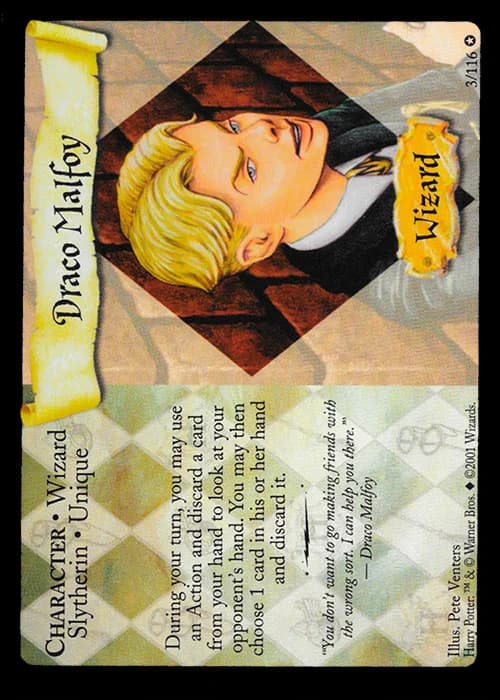
2/116 · Pete Venters
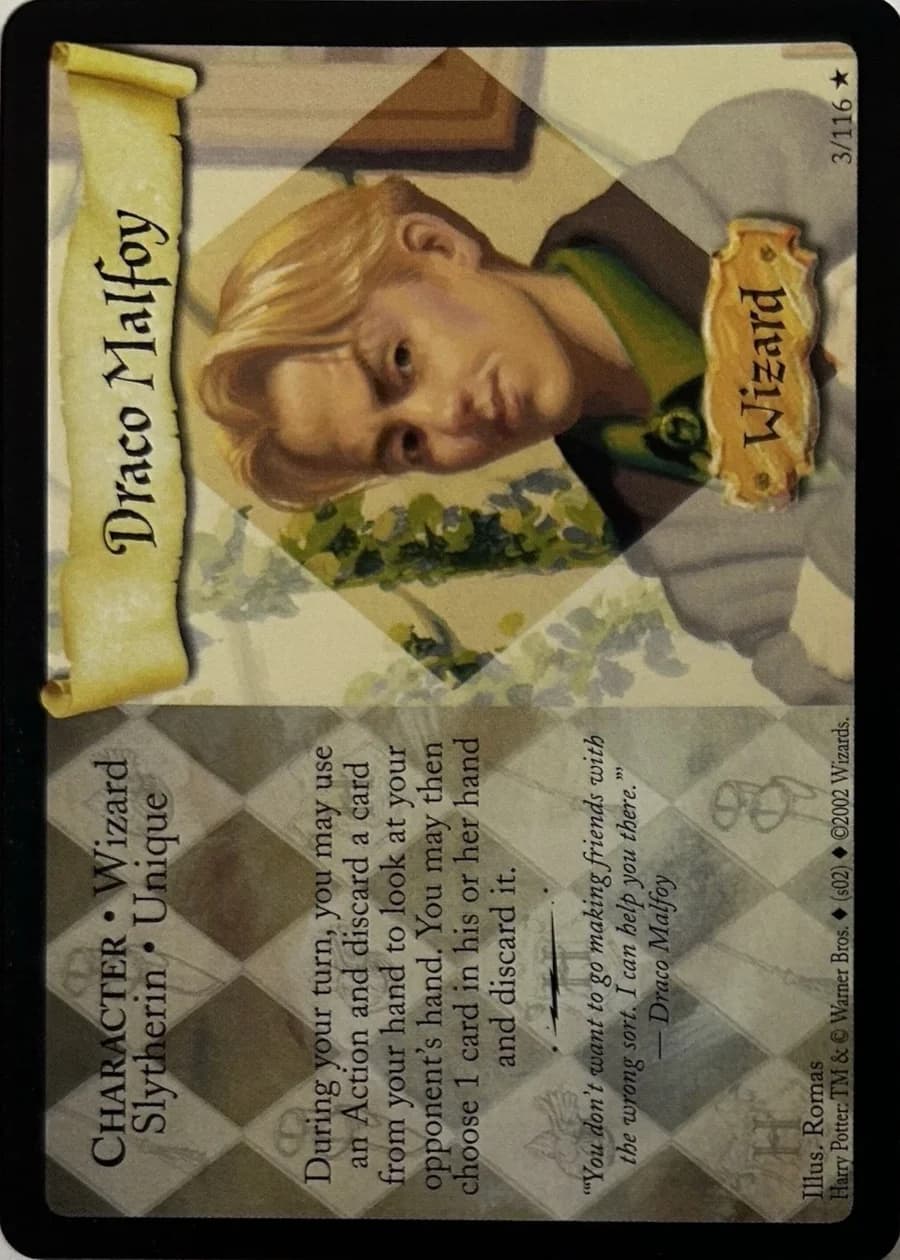
3/116 · Romas
Every promo and their origins
Promos are where this game gets genuinely difficult to catalogue, and there is one period document that explains why better than anything written since. In December 2002, a collector named Greg Hodgkinson published a full taxonomy of Harry Potter promos on Pojo. His email address was at hst.nasa.gov, which suggests the Hubble Space Telescope program employed at least one person who spent his evenings cataloguing embossed foil stamps.
His article establishes things that are still the basis of promo identification today. The first six promos, from late 2001, have a noticeably smaller promo symbol placed in the bottom right of the card or of the text box. Wizards decided the symbol was too small to notice and enlarged it for everything afterward, then moved it into the artwork to stop it competing with set symbols. Those six are the “small symbol” promos, and they are the reason two copies of the same promo can look subtly different.
There are other quirks worth knowing. Meeting Fluffy, from the Adventures at Hogwarts Game Day tournament, carries the set symbol rather than the scar, and its embossed gold text reads “LAUNCH” instead of “PROMO.” The first five league promos got a foil treatment and had their set symbol and collector number replaced with a league number, which is why Diffindo is simply numbered 1 rather than carrying a Base Set number. The last three league promos dropped the foil.
Here is the full list as this archive currently has it, in release order. Dates are month and year, which is as precise as the record gets for most of these.
| Date | Card | How it was distributed |
|---|---|---|
| 08/2001 | Diagon Alley | WotC Harry Potter TCG introduction promo |
| 08/2001 | Remembrall | WotC Harry Potter TCG introduction promo |
| 11/2001 | Bluebell Flames | Sorcerer’s Stone film release |
| 11/2001 | Snape’s Question | Sorcerer’s Stone film release |
| 11/2001 | Strategy Session | Sorcerer’s Stone film release |
| 11/2001 | Devil’s Snare | Harry Potter PC game |
| 11/2001 | Illegibilus | Harry Potter PC game |
| 12/2001 | Wingardium Leviosa! | CoroCoro Comic (Japan) |
| 01/2002 | Diffindo | League promo #1 |
| 02/2002 | Forest Troll | League promo #2 |
| 03/2002 | Hufflepuff Match | League promo #3 |
| 04/2002 | Unusual Pets | League promo #4 |
| 04/2002 | Swelling Potion | Diagon Alley Game Day tournament |
| 05/2002 | Moonseed Poison | League promo #5 |
| 05/2002 | Through the Trapdoor | Toys R Us Sorcerer’s Stone pre-order |
| 06/2002 | Meeting Fluffy | Adventures at Hogwarts Game Day tournament |
| 07/2002 | Ollivanders | League promo #6 |
| 08/2002 | Hover Charm | League promo #7 |
| 09/2002 | Forbidden Corridor | League promo #8 |
| 09/2002 | 5 Points From Gryffindor | Goblet of Fire bookstore giveaway |
| 11/2002 | Keeping Dobby Quiet | Chamber of Secrets film release |
| 11/2002 | Rainy-Day Match | Chamber of Secrets film release |
| 11/2002 | Swelling Solution | Chamber of Secrets film release |
| 11/2002 | Backfire! | Shogakukan Fourth Grade magazine (Japan) |
| Unknown | Alohomora | Italian game store promo |
What happened to the license afterward
Wizards never touched the Harry Potter trading card license again. The next company to hold Harry Potter trading card rights was Artbox, which put out sticker and trading card sets built around film photography for Prisoner of Azkaban in 2004, a different kind of product entirely, with no original art and no connection to the TCG's rules, numbering, or card pool.
The next real return came from Kakawow, which released a Phantom Harry Potter set in December 2024. That set is where the license actually went next: parallels serialized to as low as #/10, and the first one-of-one Harry Potter cards ever produced. I own the one-of-one Black Harry Potter card from that set, graded PSA 10.
A little over a year after Phantom Harry Potter, in January 2026, Upper Deck announced it had acquired a Harry Potter trading card license of its own, covering products including a 25th-anniversary set tied to Sorcerer's Stone and a Fleer Ultra Harry Potter line. Nothing about the announcement suggests any connection to Wizards' game, its mechanics, or its cards. Two different companies have now picked up this license within the same two years, more activity than it saw across the previous twenty.
What was left behind
The game was translated into French, German, Italian, Spanish, Portuguese, and Japanese. Promos went out through movie premieres, league seasons, a Toys R Us pre-order, a Goblet of Fire paperback giveaway, the Japanese magazine CoroCoro, and an Italian game store, among others. No single list of all of it was ever published by anyone official.
That is not a small loss. A trading card game with no complete checklist is a game where you cannot know if your collection is finished, cannot tell a genuine regional promo from a fake, and cannot price anything with confidence. Most of what is now known was reassembled by collectors, on forums and Discord servers, over two decades, from exactly the kind of scattered sources this article is built from.
Wizards of the Coast made a good game, sold a lot of it, and then stopped answering the phone. The people who kept playing it did the documentation themselves. This site is one more attempt at finishing that job.
Browse the full catalogue, or start with Base Set.
Sources
- 1.“Find the Magic in You With Chamber of Secrets”, Wizards of the Coast press release, October 1, 2002 via Pojo.com, Internet Archive. Source for release date, MSRPs, and product configurations.
- 2.“The State of Harry Potter”, Pojo.com, August 1, 2002 Source for the Scrye sales ranking, the cancelled chats, and the league coverage gaps.
- 3.“Rebuttal to The State of Harry Potter”, Pojo.com, August 8, 2002 Retailer and league-organiser perspective on Pokémon fallout and regional boycotts.
- 4.Greg Hodgkinson, “Anatomy of the Promo Card: Harry Potter Style”, Pojo.com, December 25, 2002 Source for the small-symbol promos, the Meeting Fluffy LAUNCH stamp, the wrapped promos, and the Devil’s Snare exchange.
- 5.“Wizards vanishing act: Retail strategy not in cards of parent Hasbro”, The Seattle Times, December 30, 2003 Source for the Hasbro retail closures, the $325M acquisition, the Nintendo suit, and the Federline case and its suspension.
- 6.Harry Potter Trading Card Game, Wikipedia Source for designer credits and set release dates.
- 7.Brothers Hildebrandt, Wikipedia Background on Greg and Tim Hildebrandt.
- 8.“Reshuffle: Unlocking The Harry Potter Trading Card Game’s Chamber of Secrets”, Card Gamer Secondary overview of the game’s commercial performance and cancellation.
- 9.“Will CGC Grade? Harry Potter TCG Playtest Beta Cards”, CGC Comic Book Collectors Chat Boards Collector account and photographs of the pre-release playtest deck. Reported, not independently verified by this site.
- 10.“2004 Artbox Harry Potter and the Prisoner of Azkaban Trading Cards”, Cardboard Connection Source for the Artbox film-card sets that followed the TCG’s license.
- 11.“Upper Deck Licenses ‘Harry Potter’”, ICv2, January 2026 Source for Upper Deck’s 2026 Harry Potter trading card license.
- 12.“The Story Behind the Cards: Kakawow’s Phantom Harry Potter”, CGC Cards Source for the Phantom Harry Potter set’s serialized parallels and one-of-one cards.
Know something this gets wrong, or have a source I haven't found? Tell me and I'll correct it.